The Forest Before Sunrise
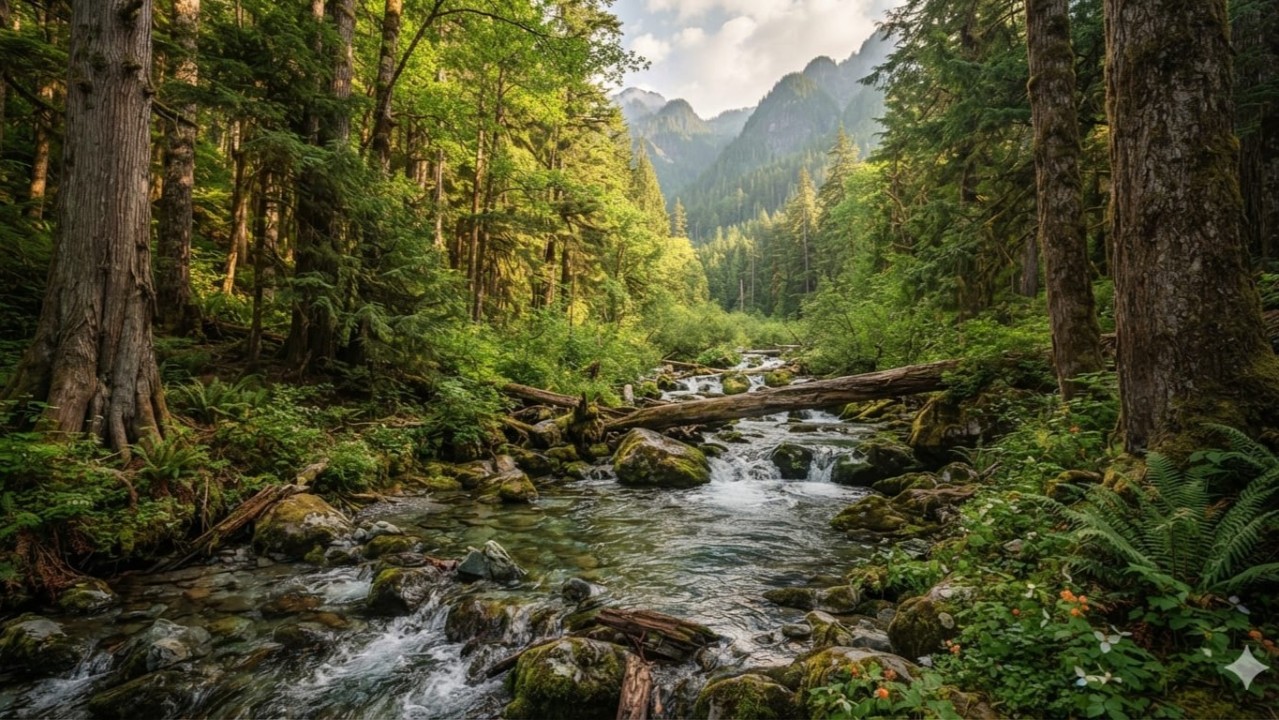
At first light, the forest appears calm. Sunlight filters through the canopy of Kakamega Forest, illuminating towering trees that have stood for generations. Birds announce the morning from different layers of the forest, while beneath the leaf litter, fungi, insects, roots, and microorganisms quietly sustain the life above them. To the casual observer, it is simply a beautiful forest. To a biogeographer, it is one of nature's most sophisticated systems of resilience.
One of the most profound lessons I have learned from years of studying forests is that resilience is rarely obvious. It is easy to admire a healthy forest—the towering trees, the cool shade beneath the canopy, the chorus of birds at dawn—but what we see is only part of the story. The true strength of a forest lies in the intricate web of relationships beneath the surface: the diversity of species, the complexity of ecological interactions, and the countless processes that quietly sustain life every day.
A forest does not become resilient when drought strikes. It becomes resilient long before the drought arrives.
The same is true for our communities, our institutions, and our societies.
As climate change accelerates across Africa, conversations about resilience have become increasingly common. Governments are developing adaptation strategies. Development partners are investing in climate programmes. Researchers are producing evidence at an unprecedented pace. Communities are responding to floods, droughts, heatwaves, and changing seasons with remarkable determination.
Yet despite these efforts, one question continues to challenge me:
Why do some systems recover while others collapse?
Nature offers an answer that is both simple and profound.
Resilience begins with diversity.
Rethinking Resilience
Resilience has become one of the most frequently used words in climate and development conversations. We speak about resilient communities, resilient agriculture, resilient infrastructure, and resilient economies. Yet the concept is often reduced to our ability to recover after a crisis.
Nature tells a different story.
Resilience is not simply the capacity to recover. It is the capacity to adapt, reorganize, and continue functioning despite change. It is built gradually through diversity, redundancy, connectivity, and continuous learning.
A forest composed of many tree species is generally more capable of withstanding pests, disease outbreaks, and climatic extremes than one dominated by a single species. Diversity creates options. When one species struggles, another may flourish. When one ecological pathway is disrupted, others continue to function.
Nature does not place all its hopes in one solution.
This principle extends far beyond ecology.
Communities with diverse livelihoods are often better equipped to withstand economic shocks. Institutions that value diverse expertise make more informed decisions. Agricultural systems that embrace diversity are generally more resilient than those dependent on a single crop. Even knowledge systems become stronger when scientific evidence is considered alongside indigenous and local experience.
Across both natural and human systems, diversity creates resilience because it creates possibility.
Looking Through Nature's Lens
Biodiversity is often described as the variety of life on Earth. While scientifically accurate, this definition can unintentionally make biodiversity appear distant from everyday life.
In reality, biodiversity is the foundation upon which human well-being depends.
Every meal we eat relies on healthy soils, pollinators, microorganisms, and diverse agricultural systems. Clean water depends on functioning watersheds, wetlands, and forests. Medicines are derived from plants, fungi, and microorganisms that have evolved over millions of years. Climate regulation depends on ecosystems that absorb carbon, regulate rainfall, and maintain ecological balance.
When biodiversity declines, these services become increasingly vulnerable.
This is why biodiversity should never be viewed solely as a conservation issue.
It is a development issue.
It is a health issue.
It is a food security issue.
It is an economic issue.
Most importantly, it is a resilience issue.
Unfortunately, environmental decisions are often made within institutional silos. Conservation is separated from agriculture. Water management is separated from land use planning. Climate adaptation is discussed independently of biodiversity conservation. Development projects are frequently implemented without fully appreciating the ecological systems upon which they depend.
Nature does not work in silos.
Neither should we.
Evidence from the Forest
Over the past several years, my work in Kenya's forest landscapes—from Kakamega to Kimondi—has repeatedly led me back to the same conclusion. The variables may differ, the species may change, and the management questions may evolve, but the underlying principle remains remarkably consistent: ecosystems become resilient because they are diverse.
Working in Kenyan forest ecosystems has provided opportunities to observe how ecological processes shape resilience over time. Research on forest fragmentation in detached portions of Kakamega Forest revealed that changes in landscape connectivity influence tree species richness and ecological integrity. Fragmentation is not merely the physical separation of forest patches; it alters ecological relationships that sustain biodiversity over generations.
Similarly, research in Kimondi Forest examining silvicultural practices demonstrated that management decisions influence woody species diversity and abundance. Practices such as thinning and pruning are often viewed as technical interventions, yet they ultimately influence how ecosystems regenerate, compete, and respond to future disturbances.
These studies may appear highly specific, but they point toward a much broader lesson.
Resilience is rarely determined by a single event.
It is shaped by the cumulative effects of decisions made over time.
Every management choice contributes to the future condition of an ecosystem.
Every planning decision shapes future vulnerability.
Every conservation effort strengthens—or weakens—the capacity of landscapes to adapt.
The same principle applies to our communities and institutions.
There are no shortcuts to resilience.
Beyond Projects
Across Africa, significant investments are being made in climate adaptation and environmental restoration. These efforts are encouraging, and many are already producing meaningful results.
Yet there is an important distinction we must recognize.
Projects have timelines.
Resilience does not.
A project may conclude after three or five years. An ecosystem may require decades to recover. A community's adaptive capacity develops across generations through education, governance, ecological stewardship, and social cohesion.
This distinction matters because resilience cannot be delivered through projects alone.
It must be cultivated.
Development practitioners often measure success through outputs: the number of trees planted, farmers trained, hectares restored, or policies developed. While these indicators are important, they do not always tell us whether resilience has genuinely increased.
The more important question is this:
Will communities be better able to respond to future uncertainty because of what we are doing today?
Nature would suggest that the answer depends less on the number of activities completed and more on whether those activities strengthen diversity, ecological integrity, learning, and collaboration.
From Science to Leadership
What, then, can leaders learn from nature?
First, resilient systems are diverse.
Whether managing ecosystems, organizations, or development programmes, diversity strengthens innovation and adaptive capacity.
Second, resilient systems are connected.
Healthy forests depend on ecological connectivity. Similarly, effective climate action depends on collaboration among governments, researchers, civil society, communities, and the private sector.
Third, resilient systems learn continuously.
Nature is constantly adapting. Institutions must do the same by embracing evidence, monitoring outcomes, and adjusting strategies as new knowledge emerges.
Finally, resilient systems invest in the future before crisis arrives.
This may be nature's greatest lesson of all.
The resilience we observe today is the product of countless investments made over time.
Likewise, the resilience of future generations will depend on the decisions we make now.
A Different Conversation for Africa
Africa possesses extraordinary ecological wealth. Our forests, wetlands, rangelands, coastlines, and biodiversity are among the continent's greatest development assets. Yet these resources are often viewed primarily through the lens of extraction or conservation rather than resilience.
Perhaps it is time to change the conversation.
Rather than asking how biodiversity can support conservation, we should ask how biodiversity can strengthen food systems, improve public health, secure water resources, create sustainable livelihoods, and reduce climate vulnerability.
Rather than viewing environmental protection as a competing priority, we should recognize it as the foundation upon which sustainable development depends.
Science provides us with evidence.
Communities provide us with experience.
Policy provides us with direction.
Only when these three come together can resilience become more than an aspiration.
Looking Ahead
Climate change is frequently described as the defining challenge of our generation.
I believe it is also an invitation.
An invitation to rethink how we design our institutions.
How we manage our landscapes.
How we value biodiversity.
How we connect science with public policy.
How we prepare future leaders.
Nature has already demonstrated that resilience is neither accidental nor immediate. It is built patiently through diversity, relationships, adaptation, and stewardship.
The question is not whether nature has lessons to teach us.
The question is whether we are willing to learn.
Questions Worth Thinking About
- Are our climate investments strengthening the ecological diversity upon which long-term resilience depends?
- How can scientific evidence become more central to environmental decision-making across Africa?
- What would our institutions look like if they were designed according to nature's principles of resilience?
From My Reading Desk
This article draws upon years of reflection informed by my own research on forest fragmentation, species diversity, and silvicultural management in Kenyan forests, alongside the growing global body of evidence demonstrating the central role of biodiversity in building resilient ecosystems and societies.
When future generations ask how we responded to the climate crisis, they may not judge us by the number of conferences we attended or the policies we drafted. They may instead ask whether we understood the oldest lesson nature had already taught us.
That resilience was never about standing alone.
It was always about standing together.
Nature has spent billions of years writing that lesson.
The question now is whether we are finally ready to read it.
Principle #1
Resilience is not built by resisting change. It is built by cultivating the diversity that allows us to adapt to it.
Emma's Reflection
Years of studying forests have convinced me that resilience is not something we discover during moments of crisis. It is something we prepare for through the choices we make every day. Every forest we protect, every landscape we restore, every young scientist we mentor, every policy we strengthen, and every community we empower contributes to a future that is better equipped to face uncertainty.
Science gives us the evidence.
Nature gives us the blueprint.
Our responsibility is to turn both into action.
Science creates knowledge. Action creates change.
Emma Anyango - www.agendabeyondborders.org